
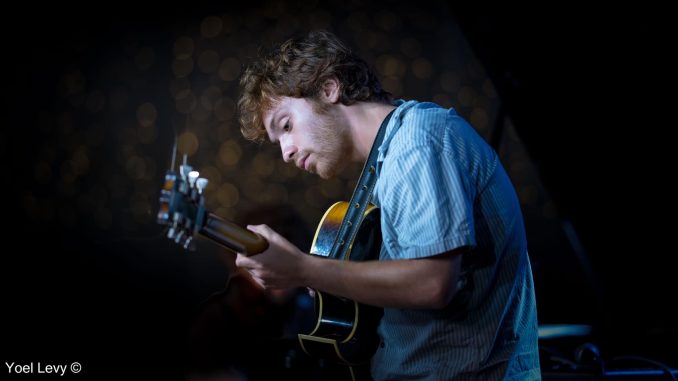
I choose to play my own tunes because I want to be original. I would never get close to the greats of this music so playing the same tunes that Wes or Grant Green played seems useless for me in terms of recording, so I try to compose my own stuff and to find my original voice.
Ron Magril
I first “met” Ron via a email introduction to check out his Inspired release, which I did. And while I was way impressed with his playing on the recording – along with his bandmates – I found quite quickly – by viewing a bunch of his youtube videos – that his playing intensified even more when he played live! This was definitely a cat that I needed to know more about so I was very pleased when he agreed to do the following interview.
In this exclusive Jazz Guitar Life interview, Ron shares his musical journey, how his Inspired recording came to be and so much more. I think you’ll dig it! So…without further adieu…may I present to you…Ron Magril…
But first…
…………
As a one-man operation, if you would like to support all the work I do on Jazz Guitar Life, please consider buying me a coffee or two. Your support helps me to focus on Jazz Guitar Life so that I can continue to bring you great interviews, reviews, podcasts and other related Jazz Guitar content. Thank you and your patronage is greatly appreciated regardless if you buy me a coffee or not 🙂 Or if you prefer PayPal – Lyle Robinson
…………
JGL: Hi Ron and thanks for taking the time to hang with Jazz Guitar Life. First off, how old are you?
RM: Thanks for having me Lyle. I’m 27 years old.
JGL: And whereabouts do you live?
RM: I live in Tel Aviv, Israel.
JGL: Nice! Now, for those who may not know you, could you give us an elevator pitch of who Ron Magril is and then we’ll get into more detail as this interview unfolds.
RM: I’m a guitar player, composer and a proud father of 2 amazing kids!
JGL: Wonderful Ron, and speaking of kids, at what age did you first get into guitar playing and were you interested in jazz from the beginning or were there other musical interests before jazz? What was the motivating experience to get you involved in this particular music and instrument?
RM: I started playing guitar when I was 10 and was mostly into old school rock and blues at that time. Around the age of 14 I discovered Wes Montgomery and completely fell in love with jazz since then.
JGL: I am not surprised that discovering Wes sealed the deal 🙂 When coming up as a young player did you attend a formal educational institution or are you self taught? Was there one – or more – particular moments that opened the flood gates so to speak as you went about learning this music?
RM: I studied jazz at a high school for the arts since I was 12 and around 14 I started to learn from my mentor and one of the best to ever do it, the great Ofer Ganor (I highly recommend checking him out!) After graduation I also studied at the New School for a short, but productive, amount of time before the pandemic (covid).
JGL: Cool. In the same vein, who has been most influential in your life as a Jazz Guitarist and why?
RM: The most influential would have to be Ofer Ganor as I was lucky enough to learn from him in my high school days. I remember going to every gig he had and transcribing his solos from YouTube videos. Another influential person would be Peter Bernstein who was my biggest idol and influence in my early days. I remember trying to play like him and I was also fortunate enough to learn from him with a few lessons that changed the world for me. For me, he’s the most important jazz guitarist of our time.
JGL: You’ll get no arguement from me in that regard! Now…who has been a major influence in your life who was NOT a guitarist and why?
RM: Yes. The first one that comes to mind is saxophonist Erez Bar Noy who was one of my first teachers at the Jazz department in my high school. He was the first person who really got me into that music. This guy loved jazz from the bottom of his heart and it was infectious. Unfortunately, he left the world way too soon.
JGL: My condolences. Taking more than a slight detour, what was your first guitar? What are you playing now?
RM: My first electric guitar was a Strat. As I mentioned before I was into blues and rock. Today I mostly use 2 guitars – a 70’s Gibson ES 175 and my favorite one – a little 1959 Gibson ES 125 which I play almost exclusively.
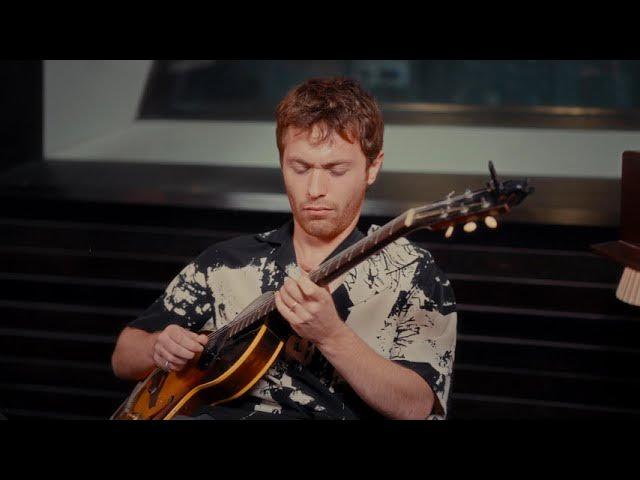

JGL: Beautiful guitars Ron. You can’t go wrong with a Gibson ES. Now…I read on your bio that – and thanks to your grandfather – that you started out your musical journey playing the violin. Do you still play and did your initial studies help you when guitar took over?
RM: My grandfather was a classical violinist and my grandmother was a classical pianist. They took me to concerts, played a lot of good music for me and helped me to take my first steps in the musical world. When I was 3 years old my grandfather tried to teach me how to play the violin but I stopped playing after a few years until I completely fell in love with the guitar around the age of 9. So I think it was a great introduction for me as a young kid to get to experiment with music and playing at a young age and I was always passionate about music.
JGL: Well your passion definitely comes through in your playing style which appears to be steeped in the post-bop/hard-bop tradition which is one of my favorite eras as well. Who were your influences on jazz guitar when you were beginning? Have they stayed the same or have they changed over the years? Who are you listening to today (guitarists or non-guitarists)?
RM: Some of My biggest influences were and still are Wes Montgomery, Grant Green, Charlie Parker, Wynton Kelly and Hank Mobley to name a few. My musical taste is always evolving and I’m always searching for new stuff to listen. For example, in the last few years I’ve gotten very much into soul jazz, soul and blues.
JGL: Nice! Tell me, when you were younger what were your band experiences like? Did you have friends who were involved in music as well or did you have to search for people to play with.
RM: When I was younger I always had a lot of friends who also played because I was a student in jazz programs since I was 12. So I played lots of sessions with friends and was a part of many different ensembles. I think this helped me a lot to gain experience, motivation and confidence as a student.
JGL: No doubt. Somewhat in the same vein, there seems to be a large Israeli Jazz community both in Israel and in New York City amongst other world locations. Is this a recent phenomenon or has Jazz always been part of the cultural background?
RM: To be honest it’s hard for me to put a finger on why Israel has such a strong jazz community but the cultural influence of America is very strong here in Tel Aviv. Most of the teachers I had, have had successful careers in NY. I think that helps to educate the next generation of musicians here in Israel.
JGL: You may be right Ron and speaking of generations, when you were young, did you know that music was something you wanted to do as a career choice and if so, what were some of the things you did to make this choice work for you?
RM: I always knew that was going to be a musician and never thought of any other career options. It might sound cliché but for me music is not a profession it’s life! I need it the same way I need air to breathe or food to eat.
JGL: Were/are your parent(s) and family members supportive of your musical career choice?
RM: My family was always supportive mentally and financially to give me the best musical education that was possible. When the pandemic started, some family members tried to convince me to study education so I would have another career option in case things didn’t go well, but I was always confident about my way and about what I want to do with my life.
JGL: Speaking of confidence, your bio states that you were “…awarded a scholarship from the New School in New York (2019), the AICF (America-Israel Cultural Foundation 2018-2020) and the Ran Baron excellence scholarships (2016). Ron was supported by the Israel’s Ministry of culture and sports (2021)”. Sounds like you’ve done well for yourself 🙂 How did these honors come about and what did you bring to the table so to speak to seal the deal?
RM: I think that it is nice to get “approval” from the music community and institutions. Unfortunately it is essential for a musician to get financial help these days but for me it’s important not to get too distracted by these kind of things and to always work hard to become a better musician. I believe that if you do that for a long time, all the other stuff would work out eventually. It just needs time and hard work.
Now about stressful situations such as competitions and gigs – I recommend to be fully prepared and to be confident about what you play so you can be focused and relaxed as much as possible.
JGL: Easier said than done methinks…lol! So, what was your practice routine like when you were beginning and what is it like now? Are there specific areas that you work on or do you just play through tunes?
RM: My practice routine changed a lot throughout the years. I think it’s important to have a practice routine especially when working on technical aspects. For years I had a practice routine that was built from few subjects that covered material I wanted to work on but in the last few years I work differently now. Sometimes I need to prepare for gigs and/or recordings so I’m working on those (I don’t read music well so I learn everything by ear) but mostly I’m just transcribing tunes, solos, comping or anything that I like. Also I work on new ideas that I have, trying to express what I feel and trying to play things I’m passionate about.
JGL: Do you give private lessons now and if so, how does one go about studying with you? Is there a particular level of student you are looking for?
RM: I teach private students only at my house. Usually I work with high school and undergraduate students on a high level and I only teach jazz guitar. I work with a small amount of students that I enjoy working with both on a professional and personal level.
JGL: Similarly, how important do you feel it is for those beginning the art of Jazz Guitar to learn in a formal setting (ie: with a teacher or in a university or conservatory setting)? Or is it still possible to get all you need from “wearing the grooves out” of records or CD’s?
RM: I feel like as a student it’s very important to learn in a formal settings but every musician needs to do the work by themselves as well, so it’s not just this or just that but the combination of the two.
JGL: With all the work that you have done musically and personally, how difficult do you find it making a living as a jazz guitar player? Or have you found it to be relatively easy?
RM: It’s hard but I never thought about it as an option so I’m working hard to be the best I can without worrying too much about how much money I make or how I’m doing, because I do what I love every day.
JGL: Nice! Reminds me of the phrase “If you do what you love, you’ll never work a day in your life“. But as working musicians, we do need to work…lol…so how do you go about searching for gigs and what have you found in your experiences that make looking for gigs easier?
RM: It depends if you are talking about getting lots of sideman gigs or as a leader but I think in both ways there’s a lot of things that make a difference. First of all is to play consistently good and to be professional by showing up on time fully, being prepared for gigs/recordings and being comfortable to work with. Also, having LOTS of patience helps!
JGL: Good advice Ron. And speaking of gigs, could you describe some of your best musical situations or experiences and the worst?
RM: Some of My best situations so far as a leader was to play my original music at the Red Sea jazz festival and to bring my quartet for a couple of shows in the UK after the release of my first album. And as a sideman, it was to tour with the Sugarman 3 in Europe last November.
About my worst situations? Well, I have a lot of situations that I feel not great about and honestly, that’s ok. Sometimes I feel great and sometimes I feel bad. I just try to accept it and learn from those moments.
JGL: That’s all one can ask I believe. Now, you have played and recorded in a variety of group configurations. Is there one specific musical situation that you enjoy playing in the most?
RM: There are a lot of groups and styles that I love to play with. For me what matters the most is the musician and not his or her instrument but I do love playing with an organ trio and to play trio with bass and drums. It really changes with time and it’s very much related to the mood I’m into at a certain time. But in general I’m into groovy, bluesy and soulful music.
JGL: Well from what I’ve seen, and heard, you seem to balance your duties as both a sideman and leader nicely? Do you have a preference overall and what is needed to succeed as one or the other or both?
RM: I love to do both and I love the combination of both because as a sideman I’m doing projects that I enjoy and as a leader I have the freedom to do what I want.
JGL: Well now, speaking of doing what you want, your most recent – and second – CD as a leader, “Inspired“, has gotten some great reviews. Kudos to you and your band-mates 🙂 Given your recorded output, you seem to write and favor your own original tunes. What is the process when composing your own tunes? Do you sit down with your guitar and come up with ideas or is it more cerebral? In the same vein, do you compose on the spot or do you need inspiration of some kind?
RM: For me composing is totally spontaneous. It just happens when I’m accidentally playing something that I like or get inspired by great music but I never succeed to write music when I decided to try to compose it just happens naturally. Sometimes I write a lot of new tunes in a short amount of time and sometimes it takes forever to compose one but I never put pressure on myself. I choose to play my own tunes because I want to be original. I would never get close to the greats of this music so playing the same tunes that Wes or Grant Green played seems useless for me in terms of recording, so I try to compose my own stuff and to find my original voice.
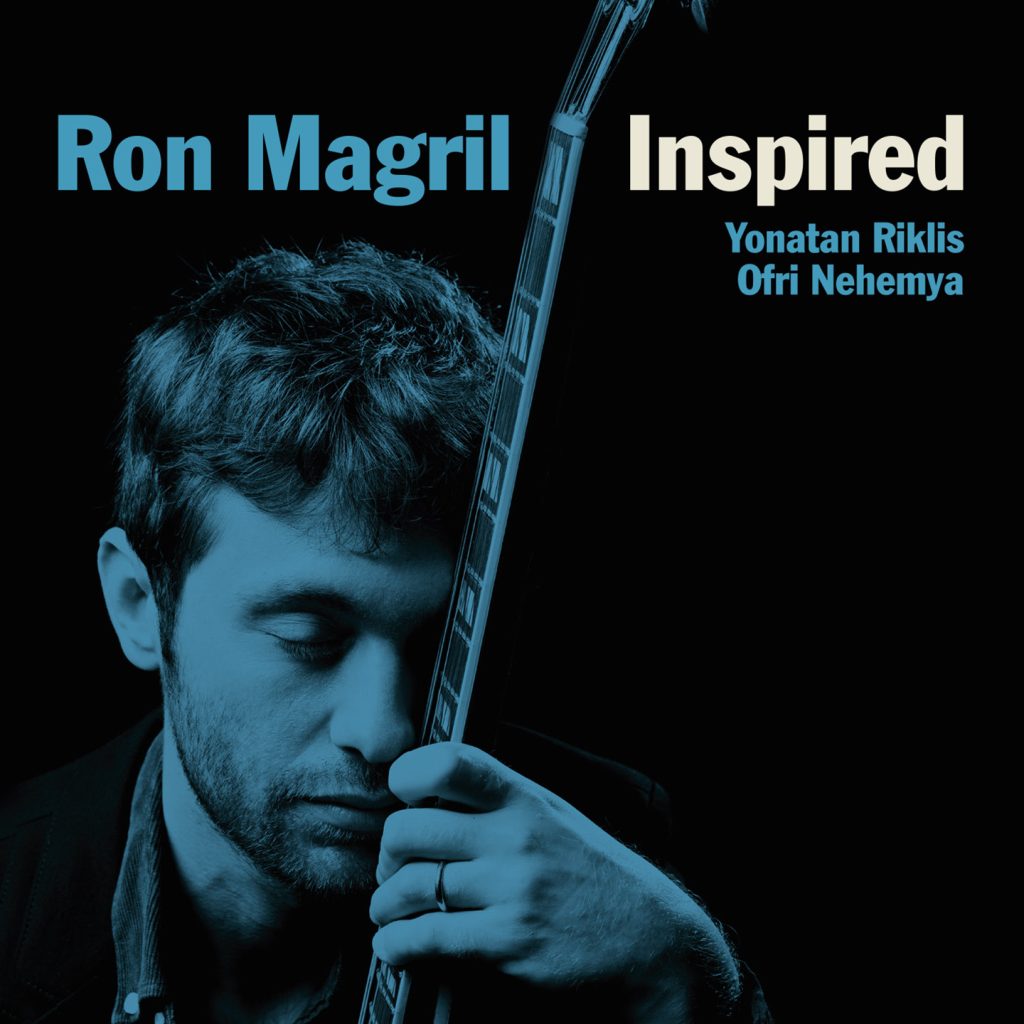
Click here to listen to Inspired!
JGL: I hear ya! How did you get into composing and how important is it to be able to compose? Would you be content just to be able to play guitar without the compositional facility?
RM: I think that as leader it’s important to compose but everyone has their own view of course. I know great musicians who don’t compose and they’re doing just fine. As I mentioned earlier, I just compose naturally. I never learned how to do it, it just happens.
JGL: Any chance of an album featuring all standards? If so, what would the track listing look like?
RM: I don’t know what would happen in the future but I think I’m going to continue to record original music. If I did do a standards record it would depend on the band I’m playing. A few of my favorites that might show up would be “Prisoner of Love”, “Here’s That Rainy Day” and “I’ve Grown Accustomed to Her Face”.
JGL: Fingers crossed that this “album” happens sooner than later…:) So, with a new release one of course needs to be market the heck out of it. How have you been getting the word out? Do you find the business side of being a Jazz musician distracting or should the playing be left to the player and the business side of things be left to the managers and agents? Do you have a manager or agent or is it all a one-man operation?
RM: I personally don’t enjoy this part of the business but as for now I’m doing what I can by myself because I care about my profession and I’m always looking to learn and get better at any aspect of this business. In the case of releasing music, I recommend working with a label/pr person for marketing and distribution. That being said I am always trying to do what I can as well as I can by trying to spread the word myself as well. I believe having a manager and an agent surely helps to make your life as an artist much easier and I feel like having one myself would be a good move for me, but at the moment it’s just me.
JGL: Well you seem to be doing ok with that so keep doing what you do 🙂 Now, as we beging to wrap up this interview and for the “gear-heads” out there, what guitar(s) do you use for live situations and studio work? Is there a special “go-to” guitar that you instinctively grab for?
RM: In the last few years I play almost exclusively on my 59 Gibson ES 125 3/4 for live situations and for recordings.
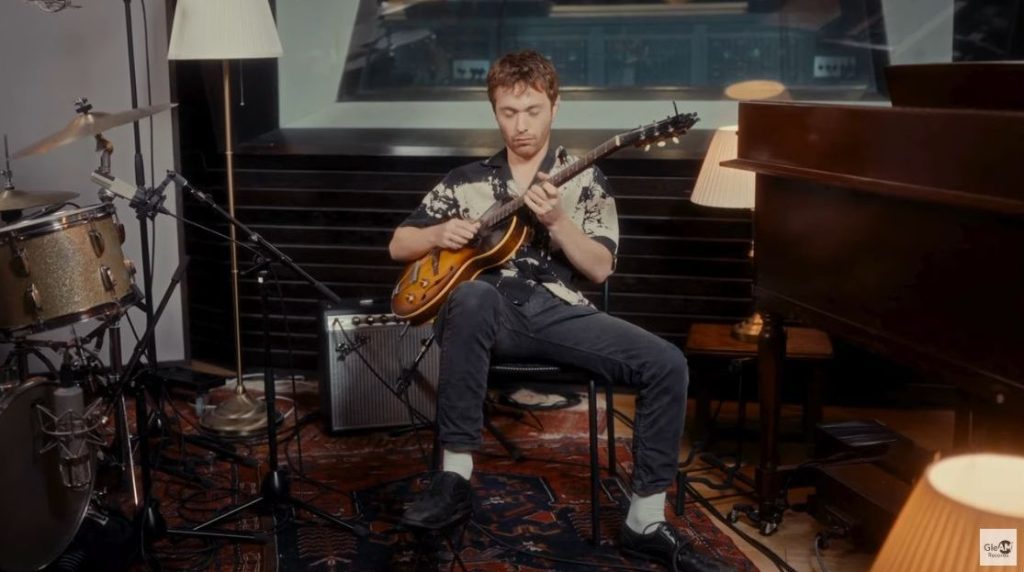
JGL: Ahhh yes, you mentioned that earlier…a nice instrument for sure. Still on the subject of gear, what do you use live in the way of amps and – if any – processing?
RM: In terms of amps I love to get that ‘warm’ ‘dirty’ sound from the tubes so it depends on the venue but for small jazz gigs I’m using my Fender Princeton Silver Face and for bigger shows/recordings I prefer a Blackface Vibrolux/Deluxe or a Twin Reverb if I can get them. I never use pedals or anything else. Just plug it in with a little reverb. I’m not a collector and don’t have much gear. I prefer to use what I have or need and nothing too fancy.
JGL: You definitely can’t go wrong with that attitude! And speaking of attitude, almost every musician, no matter their level and professional stature, has their own insecurities to deal with when it comes to music and playing their instrument. What, if any, insecurities do you face on your instrument and how do you work at getting over them?
RM: I have lots of insecurities like everyone else. But for me the first thing that comes to mind is stress. I think being stressed when playing can really be disruptive so I’m working on playing with no pressure in the studio or on the bandstand. I try to just enjoy the situation without thinking too much.
JGL: No stress or pressure sounds like the way to go Ron and thanks for sharing that with us. Tell me, have your impressions and experiences of being a Jazz Guitar player been what you had expected when you first decided to become a musician?
RM: As a kid I didn’t expect too much, I just knew I wanted to play music for the rest of my life. Making/playing music every day was my dream and I’m living it! I had, have and will have a lot of goals and dreams but anything from now is just a bonus! I’m so happy to do what I love.
JGL: And it shows in your playing and reverence to this music. In the same vein, have you ever had second thoughts about your choice to have music as a career and if so, what other career path do you think you would have followed had you not been a guitar player.
RM: I always knew that I wanted to be a musician and never thought about it as an option. Actually if I was doing something else I really don’t know what it would be. Of course I have other hobbies and things I love to do but have never found anything that gives my joy the same way that music does.
JGL: Now, not always an easy question to ask but where would you like to see Jazz Guitar go in the coming years?
RM: I hope jazz guitar and jazz music in general keeps evolving but with respect and appreciation to the history.
JGL: Nice! And any advice for the younger guy or gal who is thinking about playing jazz guitar?
RM: Just do what you really love and don’t forget to enjoy. Young people have so much stress these days because of the difficulties they have to face. I meet a lot of my students and it’s unhealthy to live like that. Putting so much pressure on your self is bad and surely not helpful, so my advice is to not forget the mental health side of things.
JGL: And the last question: What is one thing that the public may not know about you that would surprise them – ie: hobbies and such.
RM: Don’t know if that’s surprising but I love to spend as much time as I can with my family.
JGL: Wonderfully said! Thank you Ron for participating in thejazzguitarlife.com. It is most appreciated and I wish you nothing but the best.
RM: Thank you Lyle for inviting me to do this interview.
…
Please consider spreading the word about Ron and Jazz Guitar Life by sharing this interview amongst your social media pals and please feel free to leave a comment. We’d love to hear from you 🙂
If you would like to support all the work I do on Jazz Guitar Life, please consider buying me a coffee or visiting the Jazz Guitar Life sponsors. Thank you and your patronage is greatly appreciated regardless if you buy me a coffee or not…Or if you prefer PayPal 🙂

Leave a Reply